
Every enterprise AI conversation eventually arrives at the same question: how do we actually build agents that work?
Not demo agents. Not proof-of-concept agents that impress in a boardroom and collapse in production. Agents that handle real workloads, integrate with existing systems, and operate within the governance frameworks your enterprise requires.
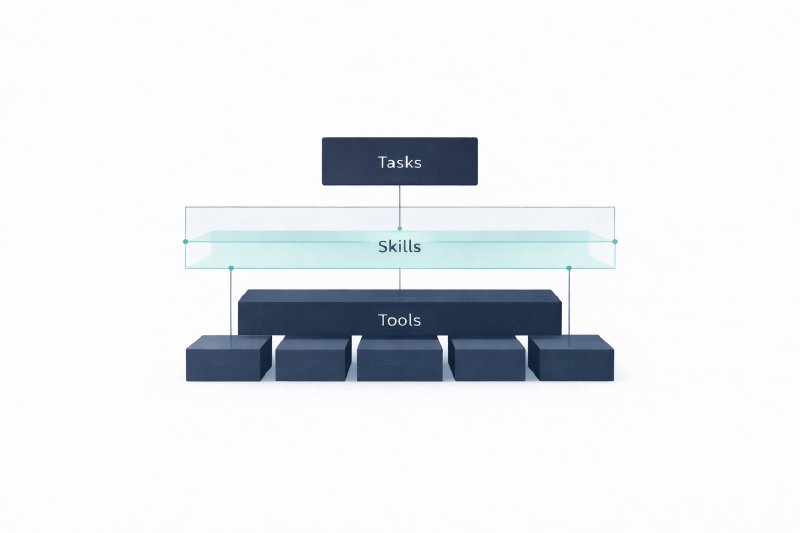
The answer begins with understanding that AI agents aren’t monolithic—they’re compositional. And the composition that matters breaks down into three distinct elements: tasks, skills, and tools. Get this trinity right, and you have a foundation for agents that scale. Get it wrong, and you’re building technical debt with a language model attached.
The problem with “just build an agent”
Most organizations approach AI agents the way they approached their first web applications in the late 1990s: with enthusiasm, minimal architecture, and the assumption that they’ll figure out the hard parts later. The result is predictable. Agents that work in demos fail when confronted with edge cases. Systems that seemed simple become unmaintainable. And the gap between what was promised and what was delivered grows wider with each iteration.
The root cause isn’t the models themselves. It’s the absence of a clear mental model for what an agent actually is and what it needs to function.
When teams build without this clarity, they conflate different concerns. They embed business logic in prompt engineering. They hardcode system access patterns that should be abstracted. They create agents that can only do one thing, one way, in one context—and then wonder why scaling is so difficult.
The tasks-skills-tools framework resolves this confusion by separating concerns that should never have been merged.
Tasks: the job to be done
A task is the atomic unit of work an agent performs. It’s the answer to the question: what are we actually asking this agent to accomplish?
This sounds obvious until you watch teams struggle to define it. “Help users with customer service” isn’t a task—it’s a goal statement that could encompass hundreds of discrete activities. “Retrieve order status for a given order ID and present it to the user” is a task. It’s specific, bounded, and testable.
Good task definitions share several characteristics. They have clear inputs and outputs. They have success criteria that can be evaluated programmatically or through human review. They have defined boundaries—what’s in scope and what triggers escalation or handoff. And critically, they have service-level expectations. How long should this task take? What’s the acceptable failure rate? What happens when the agent can’t complete the task?
Think of tasks as the contract between the agent and the business. The business cares about outcomes. Tasks translate those outcomes into specifications the agent can be measured against.
For enterprise architects, this framing should feel familiar. It mirrors how you think about service contracts, API specifications, and integration patterns. The difference is that the consumer is an AI system rather than a human user or another application. But the discipline of defining clear contracts remains essential.
Consider an agent designed to support sales operations. The tasks might include: qualify an inbound lead against defined criteria, retrieve a customer’s purchase history from the CRM, generate a draft proposal based on a requirements document, or schedule a follow-up meeting based on availability. Each of these is specific enough to implement, test, and monitor independently. Each can be governed with appropriate guardrails. And each can be improved or replaced without affecting the others.
Skills: the domain knowledge
If tasks define what an agent does, skills define how it does it. Skills are the domain knowledge, reasoning patterns, and specialized expertise that enable effective task execution.
This is where most agent implementations go wrong. Teams assume that a large language model’s general capabilities are sufficient for any task. They aren’t. Without domain-specific knowledge, agents make plausible-sounding mistakes. They miss nuances that any human expert would catch. They apply generic reasoning to situations that demand specialized understanding.
Skills address this gap by injecting domain expertise into the agent’s decision-making process. They can take multiple forms: system prompts that encode procedural knowledge, RAG-enabled knowledge bases that provide contextual information, few-shot examples that demonstrate correct reasoning patterns, or fine-tuned model weights that embed specialized capabilities.
The form matters less than the function. A skill teaches the agent something it wouldn’t otherwise know—and more importantly, something it needs to know to complete its tasks effectively.
Consider the difference between asking a general-purpose model to process an insurance claim versus asking an agent with claims processing skills. The general model might produce output that looks reasonable but misses regulatory requirements, applies incorrect coverage logic, or fails to flag indicators that an experienced adjuster would recognize immediately. The skilled agent brings that expertise to bear automatically.
For CIOs and enterprise architects, skills represent a significant investment decision. Building them requires capturing institutional knowledge—often tacit knowledge that exists only in the heads of experienced staff. But that investment compounds. A well-built skill can be reused across multiple agents, applied to multiple tasks, and refined over time as the organization learns what works.
Skills also raise important governance questions. Who owns the skill? How is it versioned and updated? What’s the review process for changes? How do you audit what knowledge an agent is applying? These questions need answers before you scale.
Tools: the access layer
Tasks define the job. Skills define the expertise. Tools define what the agent can actually interact with—the systems, APIs, and data sources that make action possible.
In the emerging terminology of AI infrastructure, tools map closely to what protocols like MCP (Model Context Protocol) call servers. They’re the connectors that give agents reach into the enterprise landscape. A tool might provide read access to a CRM, write access to a ticketing system, the ability to execute database queries, or integration with communication platforms.
The tool layer is where enterprise integration experience pays dividends. Every challenge you’ve faced with API management—authentication, authorization, rate limiting, error handling, schema evolution—applies directly to agent tools. In fact, it applies with greater urgency, because agents can interact with systems at speeds and scales that human users never could.
This is also where governance becomes non-negotiable. An agent with unrestricted tool access is a security incident waiting to happen. The principle of least privilege applies: agents should have access only to the tools they need, with the permissions appropriate to their tasks, monitored and auditable at every interaction.
The good news is that tools can be standardized. Unlike skills, which are inherently domain-specific, tools can be built once and shared across agents. Your Salesforce integration doesn’t need to be reimplemented for every agent that needs CRM access. Your authentication patterns can be centralized. Your rate limiting can be applied at the gateway.
For organizations already invested in API management, the tool layer represents familiar territory with new requirements. For those who haven’t prioritized API governance, agent adoption is about to make that investment unavoidable.
How the trinity works together
The power of this framework emerges when you see how the three components interact.
A task without skills produces generic, error-prone output. The agent knows what to do but not how to do it well. A task without tools produces hallucinated action—the agent claims to have done something it cannot actually accomplish. Skills without tasks produce capability without direction—expertise that sits unused because there’s no work to apply it to. Tools without governance produce risk—access without accountability.
When properly composed, the relationship is clear: tasks orchestrate, skills inform, and tools enable. The agent receives a task, applies relevant skills to determine how to approach it, invokes tools to interact with necessary systems, and produces an output that meets the task’s success criteria.
This composition also enables scaling patterns that monolithic agents don’t support. You can develop and test skills independently of specific tasks. You can build tool integrations that serve multiple agents. You can modify task definitions without rebuilding the entire agent. And you can govern each layer appropriately—strict controls on tool access, review processes for skill updates, business-driven decisions about which tasks to automate.
Implications for enterprise architecture
For enterprise architects evaluating AI agent initiatives, this framework suggests several priorities.
First, invest in your tool layer early. The agents are coming regardless—make sure you have governed, observable, standards-based integration patterns ready for them. MCP provides a useful starting point, but you’ll need to address what MCP doesn’t specify: authentication, discovery, orchestration, and operational governance.
Second, treat skill development as knowledge management. Skills encode institutional expertise. The organizations that systematically capture, curate, and evolve that expertise will build agents that outperform competitors relying on generic model capabilities. This is a human process as much as a technical one.
Third, define tasks with the same rigor you’d apply to service contracts. Vague task definitions produce unmeasurable outcomes. Clear definitions enable continuous improvement, appropriate SLAs, and meaningful governance.
Fourth, plan for composition from day one. The question isn’t whether you’ll have multiple agents—it’s how they’ll work together. Agents that share skill libraries and tool integrations are easier to govern, cheaper to operate, and more reliable than agents built in isolation.
Moving forward
The tasks-skills-tools framework isn’t a complete solution to enterprise AI adoption. It’s a starting point—a way to think clearly about problems that become intractable when everything is conflated.
What it provides is separation of concerns. Business stakeholders can discuss tasks in terms they understand: jobs to be done, outcomes to achieve, value to deliver. Domain experts can focus on skills: what does the agent need to know, and how do we encode that knowledge? Technical teams can build tools: what systems need to be accessible, with what permissions, under what governance?
Each conversation is cleaner because it’s not trying to solve everything at once.
The enterprises that get this right won’t just deploy agents. They’ll build an agent capability—a systematic ability to define, build, deploy, and govern AI agents across the organization. And that capability will compound over time, making each new agent faster to build, cheaper to operate, and safer to trust.
The holy trinity isn’t a destination. It’s a foundation. Build it well.